
Why Coors needs its own page
I have a separate spreadsheet just for Coors Field. I do not have one for any other ballpark. The reason is that everything I know about pricing MLB totals – bullpen exposure, starter fly-ball rate, run-line cushion, weather carry – has to be recalculated from scratch the moment the venue is in Denver. Standard totals logic does not just bend at Coors. It breaks. A 9.5 total at Coors is not a “high” total; it is a baseline. A 12.5 is not extreme. The mile-high air rewrites the math from the first pitch.
This is the only park in MLB that requires a dedicated model. The book treats it that way. The smart UK bettor should treat it that way. The rest of this piece is about how altitude rewrites totals, why the humidor changed but did not erase the effect, and how I line-shop Coors when most UK books open later than the US sharps.
5,280 feet and what altitude does to the ball
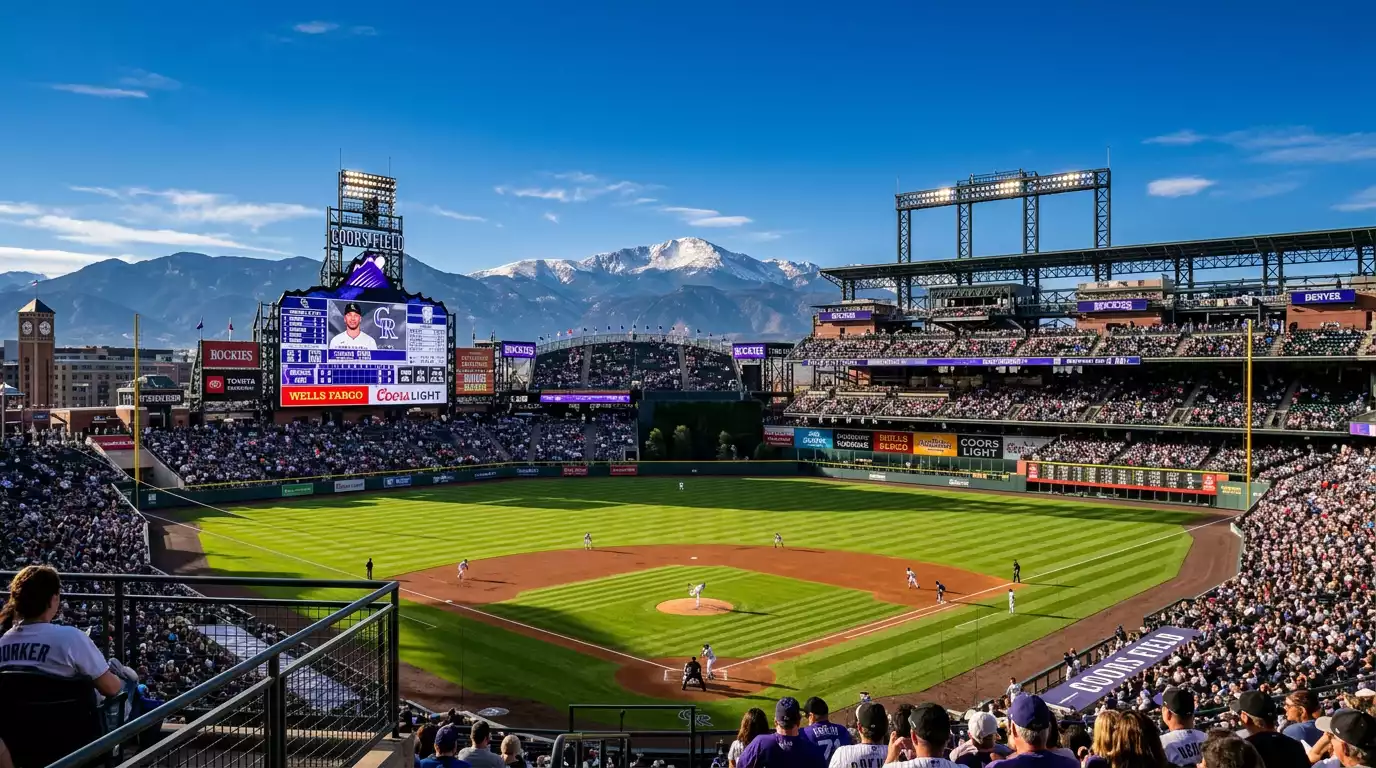
Coors sits at 5,280 feet above sea level. The air at that altitude is roughly 17 percent less dense than at sea level. That density gap is what every Coors story comes back to.
The effect on a baseball is twofold. First, the ball travels further on contact, in line with the same physics of carry that affects temperature, where a 40°F differential is worth 4-6 feet of distance – only the altitude effect at Coors is more like the equivalent of a permanent 30°F bonus on top of whatever the actual game-time temperature gives you. So routine fly outs at sea level become wall-scrapers at Coors, and wall-scrapers become home runs.
The second effect is on breaking pitches. Curveballs, sliders, splitters all move because air pressure pushes against the spin. Less air means less push, which means less break. Pitchers who live off snap on their secondary pitch see those pitches flatten out at altitude. The result is harder contact and weaker swings-and-misses, which is why Coors does not just produce home runs, it produces base hits, doubles, and long innings. Singles compound. Innings compound. Totals compound.
I will not pretend Denver weather adds nothing. A hot July afternoon at Coors can push the run environment past the historical average even further. But the baseline, before any temperature read, is already extreme.
The humidor and how it changed the model
For roughly two decades the Rockies have stored their game balls in a humidor. The mechanism is straightforward: drier balls fly further, so storing them at controlled humidity keeps them from drying out and getting “lively”. The humidor is the single biggest reason Coors totals are not 16 runs every night.
The story most public material gets wrong is treating the humidor as a fix that ended the Coors effect. It did not. It tamed it. Coors is still the most extreme run environment in MLB. The humidor brought the effect down from “stupid” to “merely the highest in the league”. For a UK bettor, the relevant point is that the modern Coors number – the totals you see today – already prices the humidor in. You do not get a free arbitrage by remembering it exists. You get a baseline that is still elevated, and you have to read every game from that baseline.
What changed in recent years is that the humidor effect can vary slightly with the rotation of new versus older balls, and with the calibration the Rockies use. Public data on this is patchy. I do not bet on it. But I keep an eye on Rockies broadcast colour-commentary mid-season for any mention of humidor changes, because the only times Coors totals have visibly drifted in either direction since 2015 have followed quiet operational tweaks.
Totals history at Coors Field
The number that matters here is run distribution. Across MLB as a whole, approximately 28 percent of all games are decided by exactly one run, which gives the standard ±1.5 run line near-coin-flip status in tight matchups. Coors does not behave like that. The one-run rate at Coors is meaningfully lower than the league average, because games tend to break open. Run lines at Coors price differently as a result, with the favourite’s −1.5 generally cheaper and the underdog’s +1.5 carrying less of a premium than at sea-level parks.
Totals at Coors over the last several seasons have averaged in the high 10s to low 11s. The over-under split is roughly even on closing totals, which is what you would expect from an efficient market – the books have done the work. So the bettable spot at Coors is not “blindly bet the over because mile-high air”. The book has accounted for that. The bettable spot is when something else is unusual: a fly-ball-prone starter the books did not adjust for, an unfavourable wind read off the Rockies (yes, Coors has wind too), a bullpen on the visiting side that has been gassed by the previous series.
I look at Coors as a place where the totals number is honest and the run-line market is the more interesting one. A wide favourite at −1.5 in Denver is paying you to bet on a likely multi-run outcome in a park that produces multi-run outcomes naturally. That alignment can be quite cheap on certain days.
What altitude does to a starting rotation
Pitching at Coors is a job most starters dread, and it shows in the year-on-year ERAs of Rockies starters. The structural effect of a less-breaking-ball environment is that pitchers who rely on movement (curveballs, sliders) underperform their season norms, while pitchers who rely on velocity and command (fastballs at the top of the zone) hold up better.
The way I use this is on visiting starters. When a low-90s breaking-ball pitcher is rolled into Coors with a pedestrian last-three lines, I assume the worst. When a high-90s velocity guy who can pitch up in the zone arrives, I trim the projected run total slightly. UK books rarely make this distinction visible in their published lines. They use a generic park-factor adjustment. So if you can read the rotation matchup against the altitude environment, there is a small but persistent edge in totals at Coors that does not exist at, for example, Camden Yards.
Bullpens are the bigger problem. Visiting relievers who have not pitched at altitude in a year or two get hammered. The cumulative effect of a series at Coors is also brutal: the third game of a Coors visit often sees a tired visiting bullpen and a tired manager who is reaching for arms with no margin. Game three over plays in a way that game one over does not, and the line rarely fully prices that schedule effect.
How UK bettors should line-shop Coors totals
UK books open Coors lines later than US books, sometimes substantially so. Pinnacle and the major US shops will have a number up by 9am UK time on a typical gameday. UK books may not post until 2pm or later, and when they do, they are anchoring close to the Pinnacle midpoint with their own margin layered on top.
The practical implication is that line shopping at Coors is more about which UK book wakes up first than about which has the sharpest pricing. By the time a 4pm UK pre-game is being assembled, most UK books are sitting within a quarter run of each other and within half a run of the US sharps. The window for a meaningful gap is the late morning, and that window closes fast.
The one consistent UK angle is that some books still treat Coors as a “novelty park” and either limit market depth or refuse alternate lines. If you want to bet a specific over of 11.5 with juice, or an alternate run line, your market depth at the average UK book will be thinner than at Pinnacle. That is a real disadvantage, and it is one of the reasons the Coors number deserves so much pre-game homework: when you pull the trigger you may only have one viable price to take.
If you also want a tighter look at parks where the totals environment runs the opposite direction – where unders earn their keep – the work I have done on pitcher-friendly MLB ballparks covers Petco, Citi Field, and Oracle, and reads as the natural counterpart to a Coors-only model.
The model that pays at altitude
Coors Field is the only MLB park where I will not bet a totals line cold. I either know the rotation matchup, the bullpen states, the wind off the Rockies, and the seasonal carry baseline, or I sit out. Because the absolute numbers are extreme, the absolute losses are also extreme. A blow-up at Coors costs more units than a blow-up at Petco, every time. The discipline that pays off is the same one that pays off everywhere – but at altitude, the cost of skipping it is twice as high.
Is the Coors Field over still profitable, or has the line caught up?
Do UK bookmakers post Coors totals later than US books?
Material created by the team DiamondLines