
Lucky 15 is a UK staple – but baseball complicates it
Walk into any UK high-street betting shop on a Saturday morning and you will see Lucky 15 slips on football and racing all over the counter. The format has been a UK favourite for decades. What surprises me, every time, is how rarely UK bettors stop to ask whether the same format makes mathematical sense on MLB. The answer is “sometimes, in narrow circumstances, with caveats” – but only if you understand exactly what the format costs you up front.
This piece is the honest version of the Lucky 15 conversation as applied to baseball. It is not telling you to avoid the format. It is telling you the embedded hold, the realistic conditions where the bonus boosts make the format worthwhile, and where the same money is better placed on cleaner singles.
Lucky 15 mechanics, refreshed
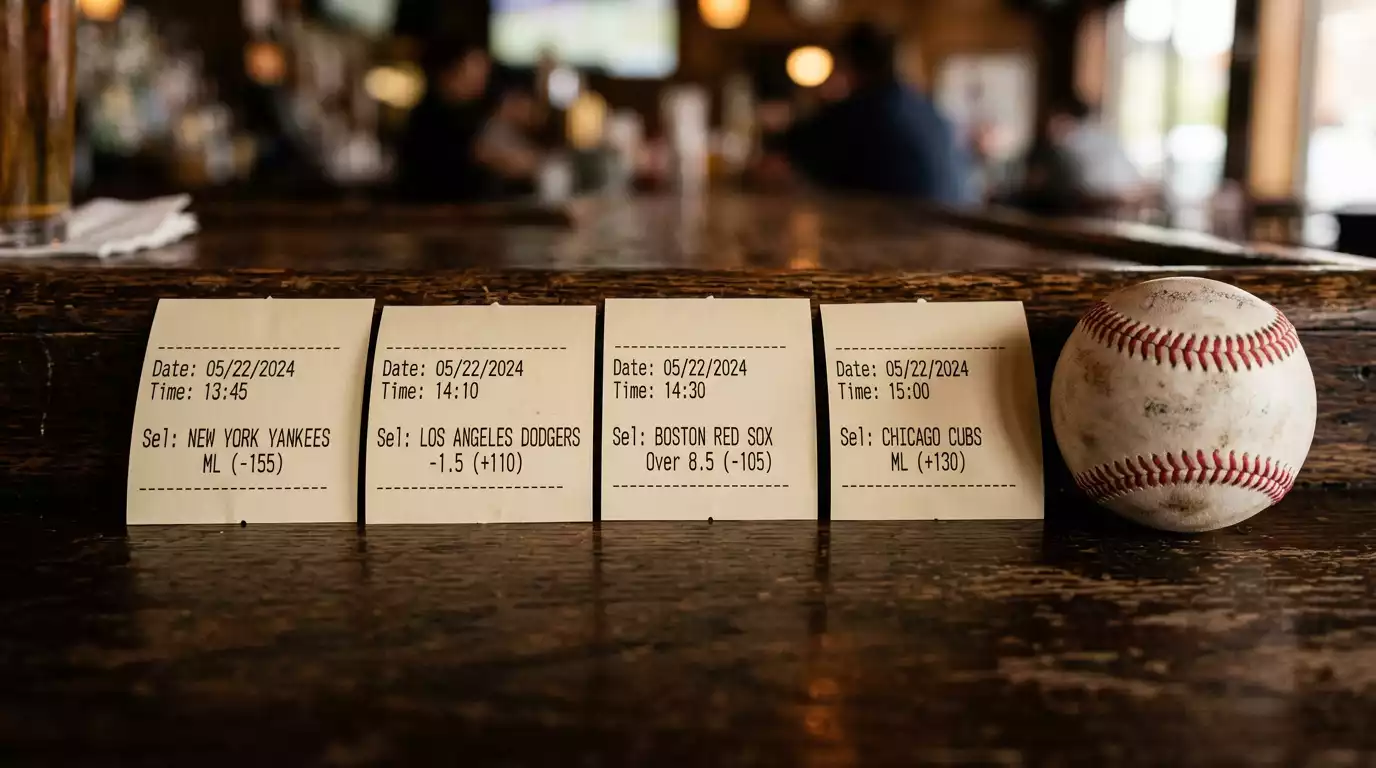
The Lucky 15 is a 15-bet ticket built on four selections. The 15 bets break down as four singles, six doubles, four trebles, and one four-fold accumulator. You stake the same unit on each of the 15 bets, so a £1 Lucky 15 actually costs £15 in total stake.
The reason it is called “Lucky” is the bonus structure. Most UK operators offer either a “single winner double odds” boost (if only one of your four selections wins, the single pays at double the listed odds) or a “all four winners bonus” of 10 to 25 percent on the total return. Some books offer both. The bonus structure is not cosmetic. It is what makes the format defensible at all on probability terms.
The mathematical reality without the bonus is brutal. A four-leg parlay at evens (decimal 2.00) returns 16.00 if all four hit, but the chance of all four hitting is one in sixteen on independent legs. A Lucky 15 spreads risk across the smaller-fold permutations to protect against bad luck, but it also limits upside compared with a single accumulator. The bonus is what tips it back toward defensible value, and only on certain operators.
Lucky 31, Lucky 63 and beyond on MLB
The Lucky 31 is the same format scaled to five selections: five singles, ten doubles, ten trebles, five four-folds, and one five-fold, totalling 31 bets. Lucky 63 is six selections producing 63 bets. Yankee, Patent, Heinz, and other formats are variations on the same combinatorial idea.
Each step up adds more permutations and more total stake. A £1 Lucky 31 costs £31. A £1 Lucky 63 costs £63. The bonus boosts scale up too, but the marginal cost of each additional selection compounds faster than the bonus value typically does.
For MLB specifically, going beyond Lucky 15 is rarely defensible. Five and six MLB selections in one combinatorial slip require independence assumptions the books do not honour – they apply correlation adjustments. The same multi-leg risk that I covered in the same-game parlay context applies here, just with the legs distributed across different games rather than within one. The result is the same structural margin disadvantage as a parlay, masked by the Lucky-format presentation. Stick with Lucky 15 if you are running this kind of ticket at all.
Hold percentage compounding across legs
Here is where the math gets uncomfortable. The hold on a Lucky 15 is the cumulative effect of the per-leg margin compounded across all the doubles, trebles, and four-fold combinations. Even at a tight book offering -110 (1.91 decimal) per leg, the embedded hold on the four-fold leg alone is roughly 18 percent before the bonus is factored in. Across the full Lucky 15 the blended hold is somewhat lower than the single four-fold, but still meaningfully higher than any individual single.
The industry-wide U.S. sports-betting hold percentage rose from 7.01 percent in 2019 to 9.13 percent in 2023, reflecting increased adoption of high-margin parlay and same-game parlay markets. UK Lucky-format products contribute to that same trend, and the operators know it. In 2024, U.S. sportsbooks retained $13.71 billion from $149.8 billion in handle, a 9.3 percent overall hold rate (up from 7.0 percent in 2019). Combo formats – Lucky 15 included – are a meaningful slice of why the blended hold has grown.
One of the cleaner expressions of the underlying problem comes from the Betstamp editorial team, who put it this way, “Sharp bettors in baseball know even their strongest edge might only be a few percentage points above breakeven, so over-weighting one pick is dangerous.” The Lucky 15 is by design an over-weighting structure – it stacks the same four picks across 15 bets. If your edge per pick is two percentage points above breakeven, the cumulative edge across 15 correlated bets is much smaller than the simple multiplication suggests, because the underlying picks share variance. You are not getting 15 independent shots at a small edge. You are getting one set of four picks expressed 15 ways.
When MLB multi-bets actually pay off
There are conditions under which a Lucky 15 on MLB makes mathematical sense. None of them involve “I really like all four picks”. The conditions are about the bonus structure overcoming the embedded hold.
The first condition is a meaningful all-four-winners bonus, ideally 25 percent or higher. A bonus of that size effectively flips the four-fold leg back into positive-expectation territory if your edge per pick is genuinely real. The second is a “single winner double odds” boost when at least one of your four picks is at plus-money – that is the leg of the format most likely to save the ticket from a total loss, and double odds on a +150 single makes the loss-protection meaningful.
The third is when you are picking four genuinely uncorrelated MLB plays – different games, different cities, different time slots. Correlated picks (four overs on a same-day slate, four moneylines all backing favourites) compound their variance the wrong way. Uncorrelated picks at least give you the spread the format was designed to deliver.
If all three conditions hold, a Lucky 15 with bonus is defensible. If any of them are missing, the same money is better placed as four flat singles at sharper UK book prices. The cost of stacking is the cumulative hold; the benefit of stacking is the bonus and the variance-spread; the math is favourable only when the benefit outweighs the cost.
UK bookmaker bonuses on multi-bets
UK operators differ meaningfully on Lucky 15 bonuses. Some offer all-winners bonuses of 10 percent. Others go to 25 or 33 percent. Some offer single-winner double odds. Others offer “winning fav” boosts where the leg with the shortest price gets a small price improvement. The bonus terms are usually in the operator’s “promotions” or “rules” section, and they vary across sports – the Lucky 15 bonus on football may not apply to baseball, or may apply at a different rate.
I would not pick a UK operator based on Lucky 15 bonuses alone. Market depth and pricing on singles matter much more across a season. But if you are going to run Lucky 15 tickets on MLB anyway, checking the specific operator’s MLB bonus structure for the format is the single most important pre-bet step. A 25 percent all-winners bonus across the right operator can flip a marginal Lucky 15 into a defensible play; a 10 percent bonus on the same selections is structurally too thin.
For UK readers who are tempted to extend the multi-bet idea to single-game combinations rather than across multiple games, the relevant work is on same-game parlay MLB, which covers the embedded margin on the within-game multi-bet format and where it differs structurally from the across-game Lucky 15.
The honest case for and against
The honest case for Lucky 15 on MLB is narrow but real. With a strong all-winners bonus, four genuinely independent picks, and a rigorous edge on each individual pick, the format can be a legitimate part of a UK MLB bettor’s repertoire. It is not the main course. It is a side dish that occasionally pairs well with the main meal of singles betting.
The honest case against is the structural one. Most casual UK MLB bettors who run Lucky 15s do so without the bonus check, without independence on their picks, and without an honest edge per leg. The format then becomes the same expensive parlay disguised as a more sensible spread. The stake is small per leg, but the cumulative hold across the slate is high enough to swallow whatever marginal edge the bettor brought to the picks.
The correct way to use the format is the same as the correct way to use any UK combo product. Read the bonus terms in detail. Test the math against the alternative of four flat singles. Run only when the answer is genuinely “Lucky 15 wins this comparison”. And never bet a Lucky 15 with picks you would not also bet as singles.
Is a Lucky 15 ever mathematically smart on MLB games?
Which UK bookmakers offer Lucky-15 bonuses for baseball?
Material created by the team DiamondLines