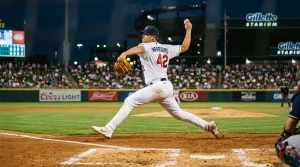

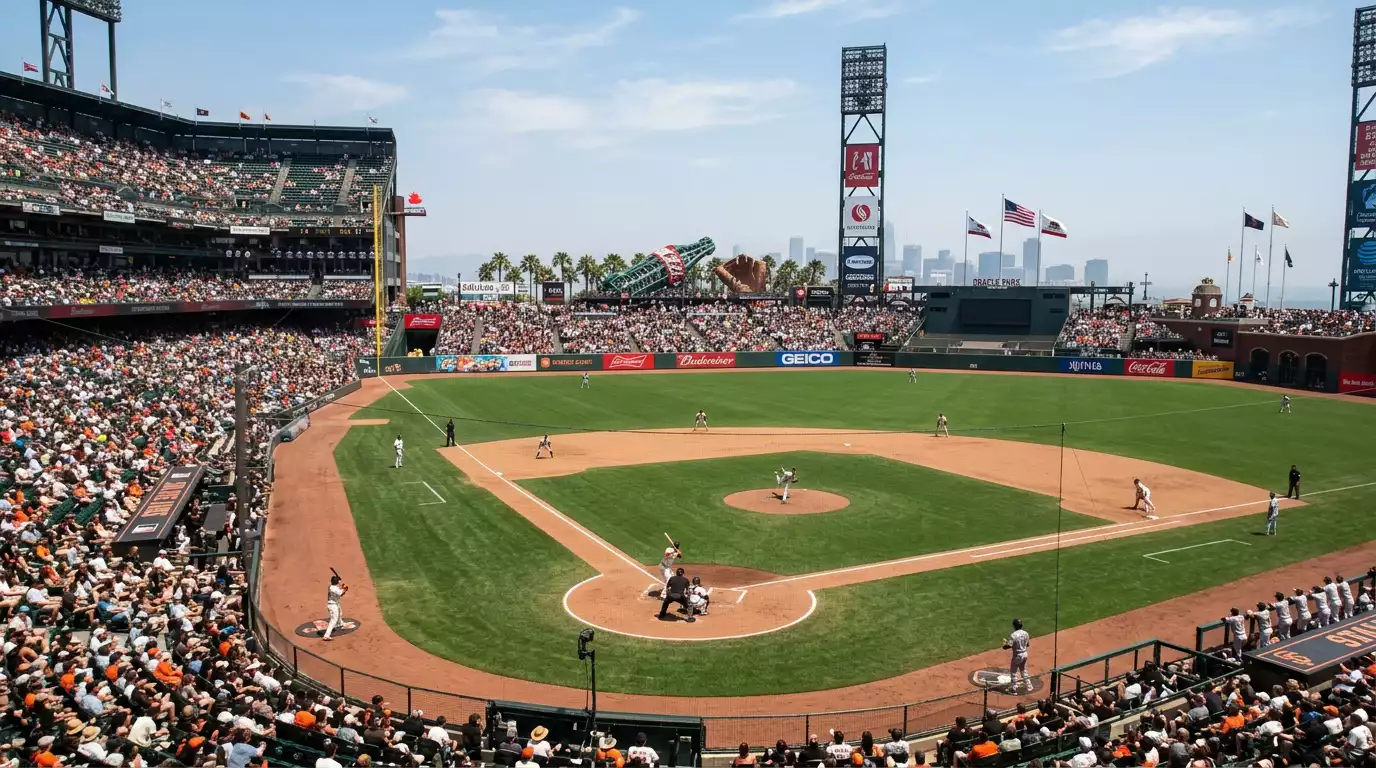
Hot air, cold air, and what they do to a baseball
The first season I tried to bet weather, I lumped temperature and wind into a single “atmospheric” column and could not work out why my totals were shapeless. The reason was simple: the two effects do completely different things to the ball, on different time scales, with different magnitudes. Wind affects the ball in flight by adding or subtracting horizontal momentum. Temperature affects the ball before it is even hit, by changing the air density it then has to travel through.
This piece is specifically about the temperature half of the equation, plus humidity and dew point, which the public conversation usually gets backwards. If you want the wind side of the same problem, you can read it as a paired study with the outfield-wind work. Treat them as separate inputs to the same model and the totals picture sharpens fast.
The physics of carry, in 200 words
A baseball flies through air, and the air pushes back. That push, called drag, scales with air density. Hotter air is less dense, so the ball meets less drag and travels further. Colder air is denser, so the ball meets more drag and dies sooner. The numbers are not subtle. A baseball hit at 90°F travels approximately 4-6 feet farther than the same ball hit at 50°F. On a warning-track flyout in cold weather, those four feet are the difference between an out and a home run.
The effect compounds with launch angle. A line drive at 18 degrees barely registers a temperature differential because it is in the air for under two seconds. A high fly at 28 degrees stays airborne long enough to feel the entire density difference. So when the question is “does temperature affect totals”, the honest answer is “yes, mostly through the home run channel, mostly on flies above 25 degrees launch angle, and mostly on parks where deep flies actually leave the yard”. That last clause is the one most public articles forget.
Hot-day totals: the over leans
The summer-month MLB schedule is essentially a long experiment on this. From mid-June to early September, average game-time temperatures across the league sit in the high seventies to mid-eighties, with regional spikes into the high nineties. Across that window, total runs trend modestly higher and home-run rates spike, which is why books quietly raise opening totals on hot-weather afternoon games even when nothing else has changed.
The over lean on hot days is not automatic, because the books know what you know. The bettable spots are at the margins. Specifically, the days where forecast temperature is meaningfully above the seasonal norm for that city – Cleveland in May at 88°F, Seattle in July at 95°F, Pittsburgh in late August at 91°F – and the total has not been adjusted to reflect the spike. UK books in particular often anchor opening totals on a generic city profile rather than a same-day forecast, which means the heat-wave game can sit on a number set for a normal afternoon.
I check the forecast against the seasonal average, look for a 7°F or larger differential, and only then consider an over ticket. With a 4-6 feet carry differential between 50°F and 90°F as my anchor, a single 10°F jump above seasonal norm is worth roughly a quarter of a run on a six-inning starter’s exposure, and a fraction more on the bullpen. That sounds like nothing until you stack it across hundreds of plays.
Cold-day suppression and pitcher grip
The opposite case, cold weather, has two components and people usually only see the first. The first is the same density story in reverse – the ball does not carry, fly balls die, home-run rates drop, totals lean under. That part is intuitive.
The second component is grip. In games below 50°F, the pitcher’s hand on the baseball changes. Spin rates drop on breaking pitches because the fingers cannot apply the same friction. Command on fastballs degrades. Walks rise. Hit-by-pitches rise. The cold game is therefore not just a lower run environment because of carry, it is also a higher walk environment because of grip, and walks are the start of innings that produce runs even without home runs.
The effect on totals is usually a net under, but the mechanism is more complicated than the public framing suggests. A cold-game under is most reliable when both starters are fly-ball pitchers (so home runs were the run-creation channel that gets capped) and least reliable when both starters are wild ground-ballers who are about to walk five batters in 50°F air. I have lost cold-weather under tickets to ten total walks in a 4-3 game more than once, and it cured me of treating the under as a default in April.
Humidity and dew point: counter-intuitive effects
This is where most of the public weather chat goes wrong, and I want to slow down because it is the single most useful paragraph in this article. Wet air, the kind of warm humid summer evening that feels heavy, is actually less dense than dry air. Water vapour molecules are lighter than the nitrogen and oxygen molecules they displace. So the intuition that humid air is “thick” and kills the ball is exactly backwards. Humid air carries the ball slightly further, not less, than dry air at the same temperature.
The dew point matters because it is the cleanest single measure of how humid the air actually is, and it is what stadium environment commentators on US broadcasts have started referencing when they say “carry’s good tonight”. A 70°F dew point at 85°F game-time is a high-carry environment, full stop. A 40°F dew point on a dry mountain night is a lower-carry environment, even if the temperature looks identical on a sports-page game preview.
I do not bet humidity in isolation. The effect size is too small relative to wind and temperature, maybe an extra foot of carry on a deep fly. But it does break ties. When everything else looks neutral, the high-dew-point game leans over by a fraction, and that fraction is enough to push a marginal ticket from “skip” to “small play”.
Opening day and early-April spots
If there is one bettable temperature window every year, it is the first three weeks of the season. April 2025 ran cold, like every other recent April, with home-run rates running below seasonal norm in the northern parks. UK casual bettors are usually still in football mode in early April, the over-betting reflex has not kicked in yet, and totals have to be reset from a winter offseason where the books default to seasonal averages.
The systematic April under play is on northern outdoor parks – Cleveland, Detroit, the New York parks, Boston, Chicago, Pittsburgh – when forecast first-pitch temperature is below 50°F and the wind is not blowing out. I am not going to suggest blind-betting that filter. But those games systematically settle below opening totals through the first three weeks, especially in night games where the temperature drops further by the seventh inning. For a UK bettor watching late, that is a coupon worth checking before bed.
The same effect runs in reverse in late August at southern parks, where heat indices in the high nineties drag totals up toward overs. The principle is the same: when the gap between actual game-time conditions and the seasonal default the line was built on widens, the line takes time to react, and that lag is the bettable window.
Park selection matters here too. Coors Field is its own animal because altitude swamps temperature. For the altitude piece of the same physics – and how it interacts with the famous Denver carry advantage – the work on betting Coors Field covers how a single park can dominate the entire weather model. For most other MLB parks, however, the temperature read I have just outlined is the one I trust.
The takeaway you can actually use tomorrow
Temperature is a small, persistent, slow-moving edge. It is not the dramatic over-night signal that wind sometimes delivers. It is a steady tilt that you build into your totals model and respect at the margins. A 4-6 foot carry difference between 50°F and 90°F is real, has been measured repeatedly, and will not go away just because the books are aware of it. The books are aware of the average effect; they are sometimes lazy about the same-day deviation. That is your spot, and it is the same spot every April and every August. Show up, do the seasonal-norm check, place small, and let the season’s worth of small plays do the heavy lifting.
Does humid air really carry the ball less than dry air?
How much do early-April cold spots tilt MLB totals to the under?
Material created by the team DiamondLines