

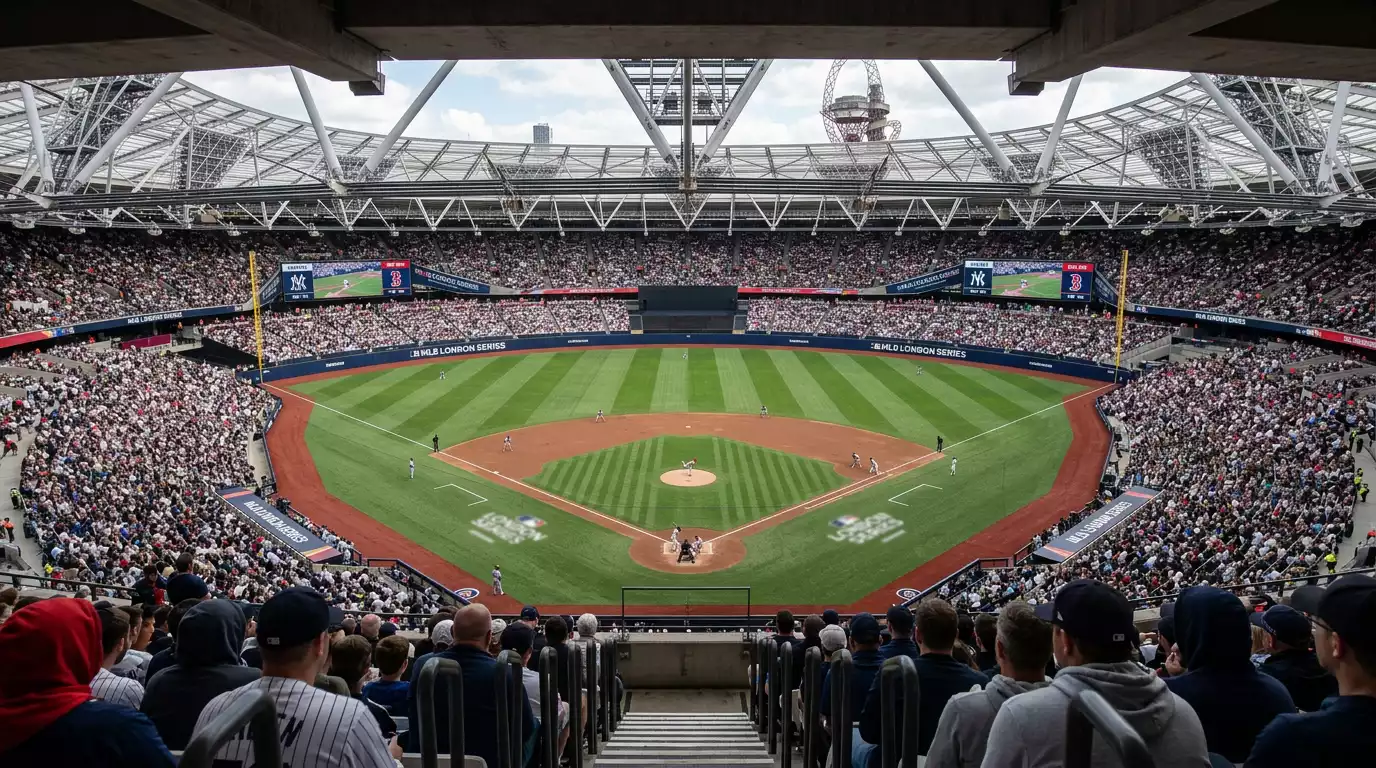
London Series is the UK’s only home MLB market
I treat London Series weekend differently from any other MLB weekend of the year. It is the one set of regular-season MLB games where the UK audience is the primary audience, where UK books deepen their MLB coverage in anticipation, and where the structural artefacts of a neutral-site game with a temporary stadium fit-out create pricing anomalies you do not see in the other 161 games of the schedule.
This is not a UK fixture in the football sense. These are full MLB regular-season games that count in the standings, and the players play them seriously. But the venue, the audience, the broadcast windows, and the betting market all behave differently enough that the London Series is worth its own pricing model. The rest of this piece is about what those differences are and where the bettable spots have shown up across the six games MLB has played in London so far.
A brief history of MLB in London
The London Series began in 2019, with two games between the Yankees and Red Sox at London Stadium that drew enormous attention and produced the highest-scoring Series of any London fixture to date. The 2023 Series brought the Cubs and Cardinals; 2024 returned with the Mets and Phillies. Each fixture has been a sellout, and MLB’s six London games to date have averaged more than 56,000 fans per game, surpassing 2019 and 2023 baselines.
The economic footprint matches the attendance. The 2024 MLB London Series (Mets vs Phillies) created an estimated $67 million economic boost for London, based on a fan survey of approximately 6,200 attendees; average attendance was 55,000 with about 71 percent UK citizens. That UK citizen share is the most important number on the page for a UK bettor. It is the reason UK books invest in London Series market depth, the reason mainstream UK media covers the matches, and the reason the betting market behaves like a UK home market for these specific games.
The other piece of UK context worth knowing is the British Baseball Federation’s domestic footprint. In 2025 the British Baseball Federation had 57 affiliated clubs and 105 league teams, plus GB national teams at U12, U15, U18 and U23 levels. That is a small but meaningful domestic baseball ecosystem, and it explains why the London Series is not seen as a one-off novelty by UK fans but as the apex event in a year-round baseball calendar.
The London Stadium totals quirk
The single biggest betting artefact across the London Series fixtures has been totals. The 2019 opener went 17-13. The 2019 second game went 12-8. The 2023 Series produced more contained scores. The 2024 Series likewise. The headline number – that early London Series games produced unusually high totals – has loomed over every Series since.
The mechanism is subtle. London Stadium is fitted out for baseball with portable infields and outfield walls that adjust the playing dimensions. The dimensions in 2019 were widely criticised as hitter-friendly: short foul lines, deep gaps, and an outfield wall configuration that combined with cool British evening air in unfamiliar ways for the visiting players. The 2023 and 2024 fit-outs adjusted the dimensions, and totals came down.
What this means for 2026 betting is that anchoring on the 2019 results is now a trap. The book will have priced the 2026 Series on the 2023-2024 totals, not on the 2019 spike. UK casual money sometimes still anchors on the 2019 narrative, which means total prices can drift toward the over on public weight. The bettable spot, when it appears, is on the under at slightly elevated totals – but only when the same-day weather (cool British evening, marine-layer-style heaviness off the Thames) supports the under, and only when the visiting starters are not extreme fly-ball pitchers who would exploit any remaining hitter-friendly geometry.
Travel, jet lag, and how books should price it
Both teams in any London Series have to travel from the US to London the week before. The jet-lag effect on baseball performance is real but small, and it has been priced into the moneyline market with rough symmetry – both teams are equally jet-lagged, so it cancels out. The asymmetric piece is the recovery direction. Teams that come from the West Coast face a longer time-zone shift than teams that come from the East Coast.
The arrival schedule also matters. Teams that arrive five days before first pitch and play exhibition games against UK clubs have visibly better Game 1 performances than teams that arrive 48 hours before first pitch. MLB’s scheduling has been generous on travel windows for the London Series, but the team that handles the arrival window better tends to play crisper baseball through Game 1 of the Series. Game 2 is a coin flip on travel terms – both sides have settled.
I do not bet the moneyline aggressively on Game 1 based on travel alone, because the price has typically already absorbed it. The more useful play is in the totals market, where the early-game timidness of jet-lagged hitters tends to push first 5 innings totals slightly under the closing number. F5 unders on Game 1 of the Series have historical support, though the sample size is small enough that I would not stake aggressively.
UK audience, handle and bookmaker focus
The numbers make the case for why UK books care about the Series. MLB UK social media channels grew 133 percent year-on-year following the 2023 London Series, and UK MLB merchandise sales rose 43 percent. That is not casual interest. That is a structural growth curve that translates directly into betting handle in the days surrounding the Series. UK books open more markets, deepen prop coverage, and run promotional offers specifically targeted at MLB during Series week.
The infrastructure has caught up too. Bases Covered Live launched on BBC iPlayer in summer 2025 with 11 weekly live games and two postseason doubleheaders – totalling 15 high-profile matchups for UK viewers. That kind of UK-native broadcast presence around the Series weekend means the public action on London games is a UK public, not a US one, and the line behaviour reflects that.
The practical implication for a UK bettor is that the London Series is one of the few weekends of the MLB year when UK book pricing genuinely diverges from US sharp pricing. UK books are pricing for UK action, which tilts public on the more famous team’s moneyline (whichever side has bigger UK media presence). That tilt creates value on the less-glamorous side, especially in the pick-em or short-favourite range.
What 2026 Series fixtures could mean for prices
Whichever teams are confirmed for the 2026 Series, the betting calendar around the games will follow a familiar shape. Markets open about three weeks ahead with totals, moneylines, and pennant-context futures specifically tied to Series results. Public action accelerates in the final week. Live markets open earlier on Series days than on regular Saturday slates because the time zone makes the games prime UK weekend afternoon viewing.
The pricing artefacts to watch are the same ones the past Series have produced. Totals priced slightly elevated due to lingering 2019 anchoring. Moneylines tilted toward whichever side carries the bigger UK following. Reduced market depth on alternate run lines and on player props that UK books do not routinely offer. The bettable spots appear in the gaps between US-sharp pricing and UK retail pricing, and they are usually narrow but recurring.
For UK readers planning to watch the Series and bet alongside, the operational side of getting a clean live signal is meaningful. The work I have done on watching MLB from the UK covers stream choices and time-zone windows, which on Series days are friendlier than on a typical Tuesday in July but still worth planning for.
The Series weekend playbook
The London Series is the one MLB weekend where I run a different playbook. Open totals checked early because UK casual anchoring on 2019 history shifts pricing. Moneylines checked late because UK action concentrates near first pitch. F5 unders considered on Game 1 specifically. Travel-fatigue narratives discounted in favour of weather and dimensions. UK book pricing compared aggressively to US-sharp pricing because the gap is wider this weekend than any other. None of this is a guaranteed edge, but the alignment of structural artefacts gives the disciplined UK bettor more bettable spots in three days than most non-Series weeks.
Are London Stadium totals systematically high or low?
Do UK bookmakers offer better depth on London Series than regular-season MLB?
Material created by the team DiamondLines