

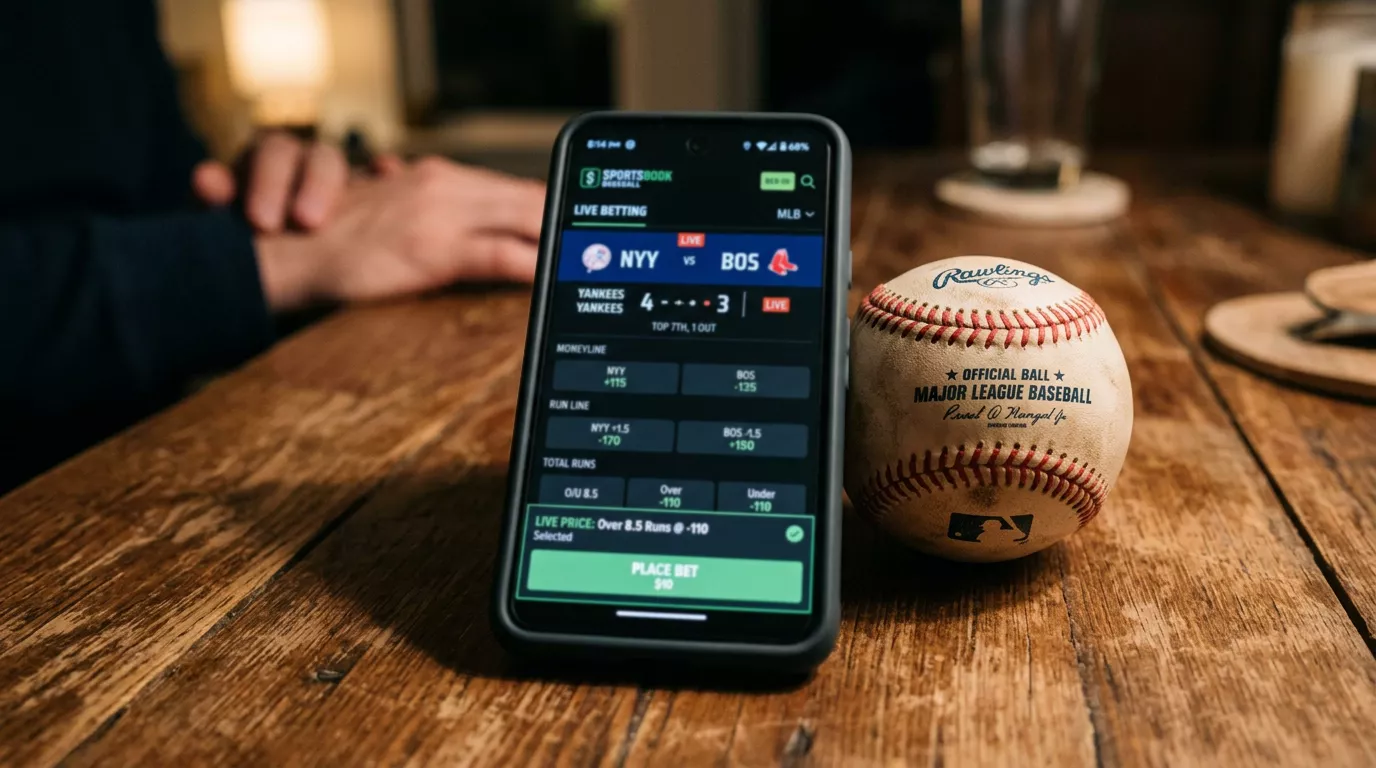
Cash-out is a margin product, not a risk tool
Every UK book frames cash-out as a flexibility feature: “take control of your bet, exit early, lock in a profit”. The framing is good marketing and slightly misleading. Cash-out is structurally a margin product. The price the book offers you to settle a still-live MLB bet is, on average, worse than the bet’s true mathematical value at that moment. Sometimes meaningfully worse.
That doesn’t mean it’s never the right choice. There is a narrow set of MLB scenarios where cash-out genuinely protects a bankroll or converts a noisy outcome into a clean exit. The point of this article is to draw a circle around exactly those scenarios, and to make clear what’s happening on the rest of the cash-out offers you’ll see scrolling across your bet slip during a normal MLB Tuesday night.
How cash-out is priced inside the book
Mechanically, cash-out is just an in-play hedge that the bookmaker calculates and offers in one click. They take the current implied probability of your bet winning, convert that to a fair value, and subtract their cash-out margin. The margin isn’t disclosed and varies by operator and market.
To put a frame on it, US sportsbook hold figures crept from roughly 7% in 2019 toward 9% by 2023 across the legal market. Cash-out adds margin on top of that, because the operator is now charging you twice – once on the original bet, and again on the early-exit transaction. On a typical UK fixed-odds MLB cash-out offer, you can expect the offered amount to sit somewhere between 80% and 95% of the bet’s true mathematical value, depending on how live the market is and how much in-play action the book is taking.
The cash-out price gets less generous in two predictable situations. First, when the market is moving fast and the book has uncertainty about its own number – they widen the cash-out margin to protect themselves from being hedged into a bad position. Second, when the bet has a long way to run, like cashing out a futures bet on the World Series in mid-July when there are still ten weeks of regular season ahead. The further from settlement, the wider the margin.
When cash-out actually helps a UK bettor
I’ll be specific about the scenarios where I genuinely click cash-out, because there are only a few. The first is bankroll protection on a long-priced live winner. If I bet a +280 underdog before first pitch and they’re up 4-0 in the seventh inning with a 1-2-3 bullpen behind their starter, the book might offer me 75% of my potential payout to settle. The math says holding to settlement has higher expected value, but the variance of the seventh-inning bullpen blow-up is real, and locking in a substantial profit can be the right call when that single bet represents an outsized share of weekly bankroll.
The second scenario is a hedge against a futures bet that has shortened dramatically. If I backed a team to win their division at 8/1 in March and they’re 2/5 with two weeks left in September, cash-out lets me convert the futures position into cash without waiting for settlement. The book’s cash-out price will be worse than the implied 2/5, but the certainty of cash now versus the risk of an injury or collapse over two weeks is sometimes worth the margin haircut.
The third – and this is the one I almost always defend – is when a bet’s premise has changed structurally. A starting pitcher gets pulled in the third inning with arm trouble. An MLB game gets called after five innings due to weather and your over wager has no real path to settling. In those cases the live market is reflecting new information your original bet didn’t price, and cash-out is the cleanest way out.
Outside those scenarios, the cash-out button is mostly a behavioural trap. The instinct to lock in a profit is psychologically powerful and mathematically expensive. Most cash-outs I’ve seen UK bettors take are emotional, not analytical.
Cash-out vs hedge bet on a different exchange
Once you understand cash-out as a margin product, the comparison to a manual hedge becomes obvious. If your live MLB bet has gained value and you want to lock something in, the cleanest approach is often to lay the same selection on Betfair Exchange or Smarkets at the current price. The exchange charges commission, typically 2-5%, which is often less than the implicit margin on a same-book cash-out.
The arithmetic is straightforward. Suppose I bet £100 on a team to win at +200 pre-game, they’re now -150 favourites in-play, and my book offers £170 cash-out. On Betfair, I could lay the same team at the current 2.50 odds for £120 stake at risk, locking in a guaranteed profit of around £180-185 after commission depending on which outcome hits. The exchange hedge gives me roughly £15 better than the book’s cash-out – money I’d otherwise be handing back across the counter.
The trade-off is friction. A cash-out is one click. A manual hedge requires two accounts, real-time math, and confidence under pressure. For a casual bettor, the friction usually wins and cash-out is the practical choice. For a regular MLB bettor managing meaningful sums, learning the manual hedge is one of the highest-ROI skills available.
One important warning: never assume the exchange price will hold while you’re calculating. MLB in-play markets move fast. Decide your hedge size and price tolerance before you open the exchange tab.
Partial cash-out: small good idea, big trap
Partial cash-out – taking some money off the table while letting the rest ride – is genuinely useful in the same scenarios where full cash-out makes sense, scaled down. If I bet a futures market on a team to make the playoffs and they’re now nearly locked in, partial cash-out can return my stake while leaving meaningful upside on the original bet. That’s a sensible bankroll-management move.
The trap is more common than the use case. UK books promote partial cash-out aggressively because it generates more transactions and more margin per bet. A bettor who would have held to settlement now does three or four partial cash-outs over the course of a game, and each one carries the same hidden margin. By the time the bet settles, the cumulative haircut can swallow most of the original edge.
The cleanest rule I give friends learning the feature: decide before you place the bet whether you’d consider any cash-out, full or partial, and at what trigger. Writing down “I’ll partial cash-out 50% if my underdog is up two runs after the seventh” turns it into a plan. Reaching for the button mid-game because you’re nervous turns it into emotional management at the operator’s preferred price. The first is a strategy. The second is a slow leak.
Discipline and UK self-exclusion tools
One thing I’ve watched cash-out do over and over is keep bettors engaged longer than they intended. The button is right there. The screen refreshes every few seconds. Each cash-out is a micro-transaction that resets the action loop. For a UK bettor who’s already brushing up against affordability triggers, that pattern matters.
Since the £150 net-loss threshold for light-touch financial vulnerability checks came into effect from 28 February 2025, regular cash-out activity is now part of the behavioural picture UK operators are required to consider. Cumulative net losses are calculated across deposits and withdrawals, and a bettor who’s running heavy cash-out volume will hit those thresholds faster than someone placing the same wagers and letting them settle naturally.
The UK responsible-gambling toolkit pairs naturally with cash-out discipline. Deposit limits, time-out periods, and reality checks are all available on every UKGC-licensed operator. I don’t bring this up to lecture – I bring it up because cash-out behaviour is often a symptom rather than a strategy. If you find yourself reaching for cash-out to manage anxiety rather than to manage value, the right intervention isn’t a better cash-out rule. It’s a deposit limit.
For deeper context on how cash-out interacts with live markets generally, the strategic frame in MLB in-play betting piece sits alongside this one.
The cash-out rule that protects more than it costs
If I had to compress this into a single working rule, it would be: cash-out only when the bet’s underlying premise has changed, or when the position has grown large enough that variance threatens bankroll structure. Outside those two cases, hold to settlement. The expected value math says so, and the long-term records of disciplined bettors say so. The button is always there. Reaching for it should feel like an exception, not a habit.
FAQ
Is cash-out always a bad deal on MLB?
Where does partial cash-out actually pay off?
Material created by the team DiamondLines