
The three parks where unders earn their keep
I keep a single mental shortlist of MLB venues where the under is a starting position rather than a contrarian take. There are three names on it: Petco Park in San Diego, Oracle Park in San Francisco, and Citi Field in New York for the Mets. Different cities, different mechanics, same outcome. These are the parks where if everything else is neutral, I tilt under before I have read a single line of pitcher form.
This is not a generic “park factor” overview. The wider park-factor literature exists, the books are aware of it, and the average game at the average park is fairly priced. The reason these three parks are worth a focused read is that the size of the suppression effect at each, paired with bullpen and umpire interactions, often outpaces what UK books bake into the totals number on a given afternoon.
Petco Park: marine layer mechanics
Petco’s reputation as a pitcher’s park goes back to the day it opened, but the mechanism most readers underestimate is the marine layer. The cool, dense ocean air that rolls in from the San Diego coast in the late afternoon and evening is heavier than the daytime atmosphere, which kills carry on fly balls. The same warning-track flyout that drops in the seats at a hot inland park stays a flyout at Petco.
The compounding factor is the dimensions. Right field at Petco is generous, the centre-field gap is deep, and the alleys play long. Combine deep dimensions with dense marine air and you have a venue where home-run rates run measurably below league average and where doubles are caught instead of dropping. Totals at Petco have historically settled in the high sevens to low eights when other parks of the same era were sitting at nines.
What I watch on a Petco gameday is the night-versus-day distinction. A 1pm Saturday Petco game in May behaves like a more normal park because the marine layer has not rolled in yet. A 7pm Saturday Petco game in May plays like a vault because the cool ocean air has settled by first pitch. UK books do not always price that intra-day difference. The under window at Petco is mostly on the late starts, especially in spring and early summer, and especially when both starters are fly-ball pitchers who lose ground to the dense air.
Oracle Park: wind tunnel and triples
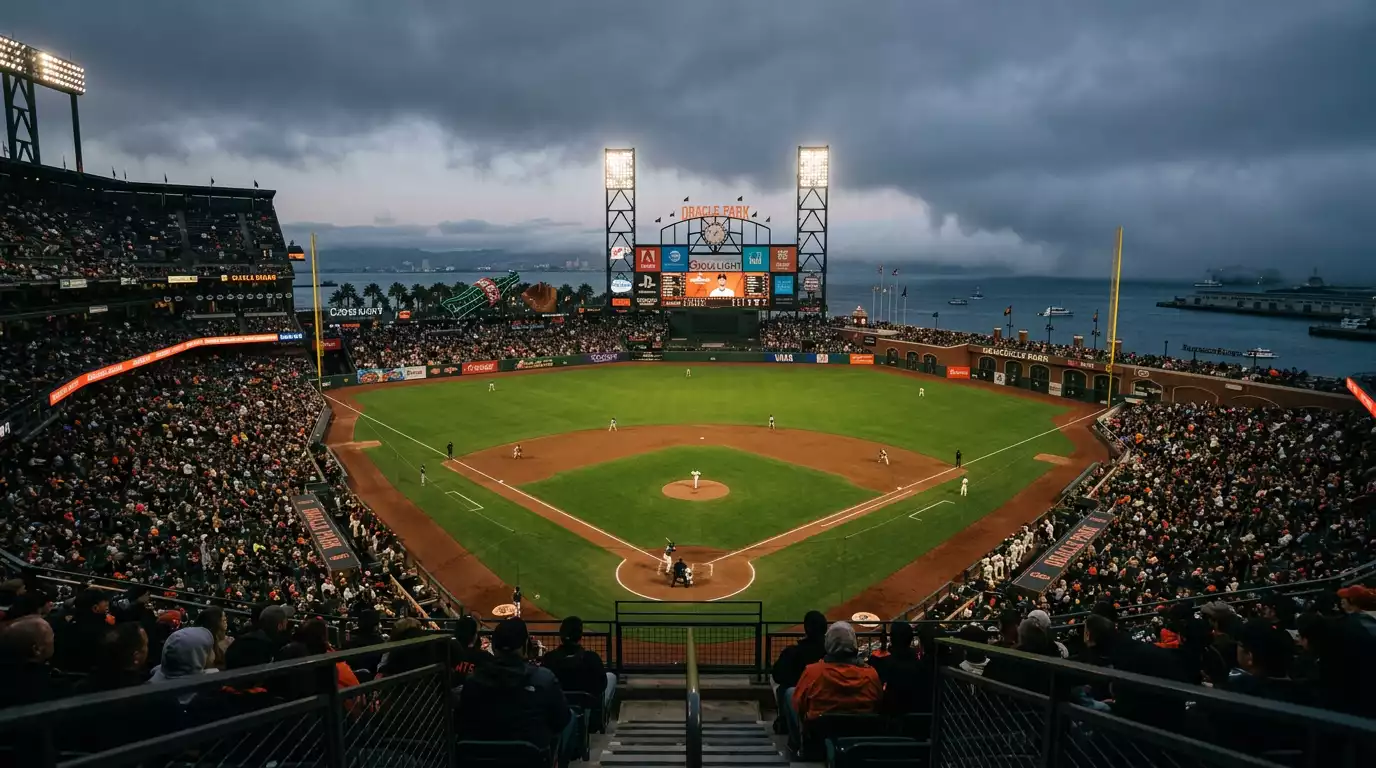
Oracle, formerly AT&T Park, is the same story with a different shape. It is in San Francisco, which has its own marine layer story, but the dominant feature at Oracle is the geometry of right field and the wind that lives there permanently. The right-centre alley is one of the deepest in baseball, and the prevailing wind off the bay during summer pushes balls toward triples alley rather than out of the park.
The result is a park that suppresses home runs while keeping batting average and doubles roughly normal. Pitchers love Oracle because their hardest-hit fly balls die at the warning track. Hitters who depend on pull-side power get punished. The triples count at Oracle has historically run higher than league average, but a triple is worth one run plus one extra base. A home run is two-plus runs in many spots. The exchange – turning home runs into triples – is a net under for totals purposes.
The bettable Oracle situation is not “always under”. The book knows. The bettable situation is when a heavy fly-ball, pull-side starter from the visiting team is on the mound at a venue that turns his profile inside out, and when the totals number has not been adjusted hard enough to reflect the matchup. On those days, a small under has structural backing.
Citi Field: deep gaps
Citi Field is the third name on the list, and it is the one that most casual UK bettors miss. The Mets’ park is not a “marine layer” venue, but the gaps are deep, the foul territory is generous, and the wind off Flushing Bay is a meaningful drag on right-field power. Citi Field plays as a moderate pitcher’s park year-round, less extreme than Petco or Oracle but consistent enough that it shows up reliably in park-factor data.
What I find useful about Citi is that it sits in New York, which means it gets more public action than the West Coast parks, and that public action does not always know the field. The Mets’ totals on hot summer evenings can drift up because the public sees “summer game in New York, hitters’ month” and the line absorbs the chatter. The under at Citi on a humid August evening with two competent starters is the kind of unspectacular but recurring play I would rather have on my coupon than a dramatic Coors over.
Park factor numbers UK bettors can trust
The honest answer to “what park factor should I use?” is: a multi-year rolling average from a public source, not the most recent season. A single-season park factor is noisy. Three or five seasons combined is reliable. The reason is the same reason I trust the league-wide one-run-game ratio of approximately 28 percent over any single year’s number: across many MLB games, structural effects show up cleanly, while in a single sample they get drowned by variance.
Three caveats on park factors. First, they are average effects, and the average effect is small relative to the matchup-specific effects (pitcher type, weather, bullpen state). Second, they shift slowly when stadiums are renovated or fences are moved, so a 2018 park factor is no longer reliable for a 2025 dimension. Third, for the purposes of betting, what matters is whether the line has already absorbed the park factor. Most of the time, it has. The edge is in the residual differences – the same-day weather, the rotation matchup – that the line has not.
For UK readers, free park-factor data is available from the major US analytics platforms and from the official MLB advanced stats site. Three-year rolling averages of “park factor for runs” and “park factor for home runs” are the two columns I keep in my own spreadsheet. I would not pay for premium park-factor feeds. The free data is good enough.
Stacking park factors with home-plate ump tendencies
This is where the article earns its keep. A pitcher-friendly park is good. A pitcher-friendly park with a pitcher-friendly umpire is better. And that interaction is something most UK bettors never look at.
The umpire data on this is striking. When home-plate umpire Ron Kulpa is officiating, MLB unders have gone 254-190-25 for a 57.2 percent hit rate, with +46.75 units profit and a 10 percent ROI in the historical Bet Labs database. That is a single umpire, and that is one specific lifetime under-leaning profile. There are several umpires in the modern roster who behave the same way, calling a wider strike zone, lowering walk rates, accelerating pace of play, and tilting outcomes toward the pitcher.
When you stack a Kulpa-type ump on a Petco evening or an Oracle late game with both starters being competent strikeout arms, the under is not just a position, it is a pile-on. As Hard Rock’s editorial framing on run lines puts it, “If your read on totals, bullpen edges, and home/road dynamics points to a multi-run outcome, -1.5 can pay you for the bold call; if the matchup screams nail-biter, +1.5 or the moneyline is the smarter lane.” The stacked-under spot is the inverse: if your read on park, ump, and pitcher all points one direction, you do not need bold, you need patient. Small ticket, repeat through the season, and let the alignments compound.
Where to apply this and where to skip
I do not chase pitcher-friendly parks blindly. The unders are not free. The ones I take are when at least two of three signals align – park, ump, and matchup – and when the closing totals number has not been moved aggressively to absorb the alignment. UK books are usually slower than US sharps to incorporate same-day umpire announcements, which is one of the few systematic edges available to a UK bettor without a paid data feed.
The other half of the work is knowing which parks I avoid. The same logic that elevates Petco, Oracle, and Citi as under-friendly applies in reverse at Coors and at the Cincinnati and Yankee Stadium environments where home-run-friendly geometry compounds. The lesson is that park factors are not a thing you read once and apply forever. They are an input, and they earn their place by interacting with everything else on the slate. For the carry side of that same conversation, looking at the wind effect on MLB totals is a useful next step, because wind direction at Petco and Oracle interacts with their geometry in ways that can flip the under play on a given afternoon.
The discipline behind the under
Pitcher-friendly parks reward boring discipline. They do not reward the dramatic call. The under at Petco on a 7pm May game is the kind of pick that does not impress anyone in the group chat and pays consistently anyway. That is the bargain. If you want to bet headlines, go find a Coors over and live with the variance. If you want the slow, recurring edge that survives a 162-game season, learn the three parks where unders earn their keep, then learn the umpires who stack on top, and put in the time before first pitch.
Are park factors stable enough to bet on, or do they shift season to season?
How do you combine a pitcher-friendly park with a low-scoring umpire profile?
Material created by the team DiamondLines